Laura: “You weren’t watching me!”
Me: “No, I could hear you. I knew what you were doing. I was watching the audience to see what change you produced in them.”
Laura had asked me to be there when she presented at an industry conference with hundreds of potential customers. The revenue potential was enormous if she was successful with her presentation. I spent several days coaching her to get her messaging, and the way she delivered it, just right.
The big day came. I was watching the audience like a hawk. I wanted to see the audience reactions from the moment she said “Hello”, all the way through exactly how they looked as she walked off the stage. Were they looking at her with admiration as they applauded? Or shuffling around and checking their phones?
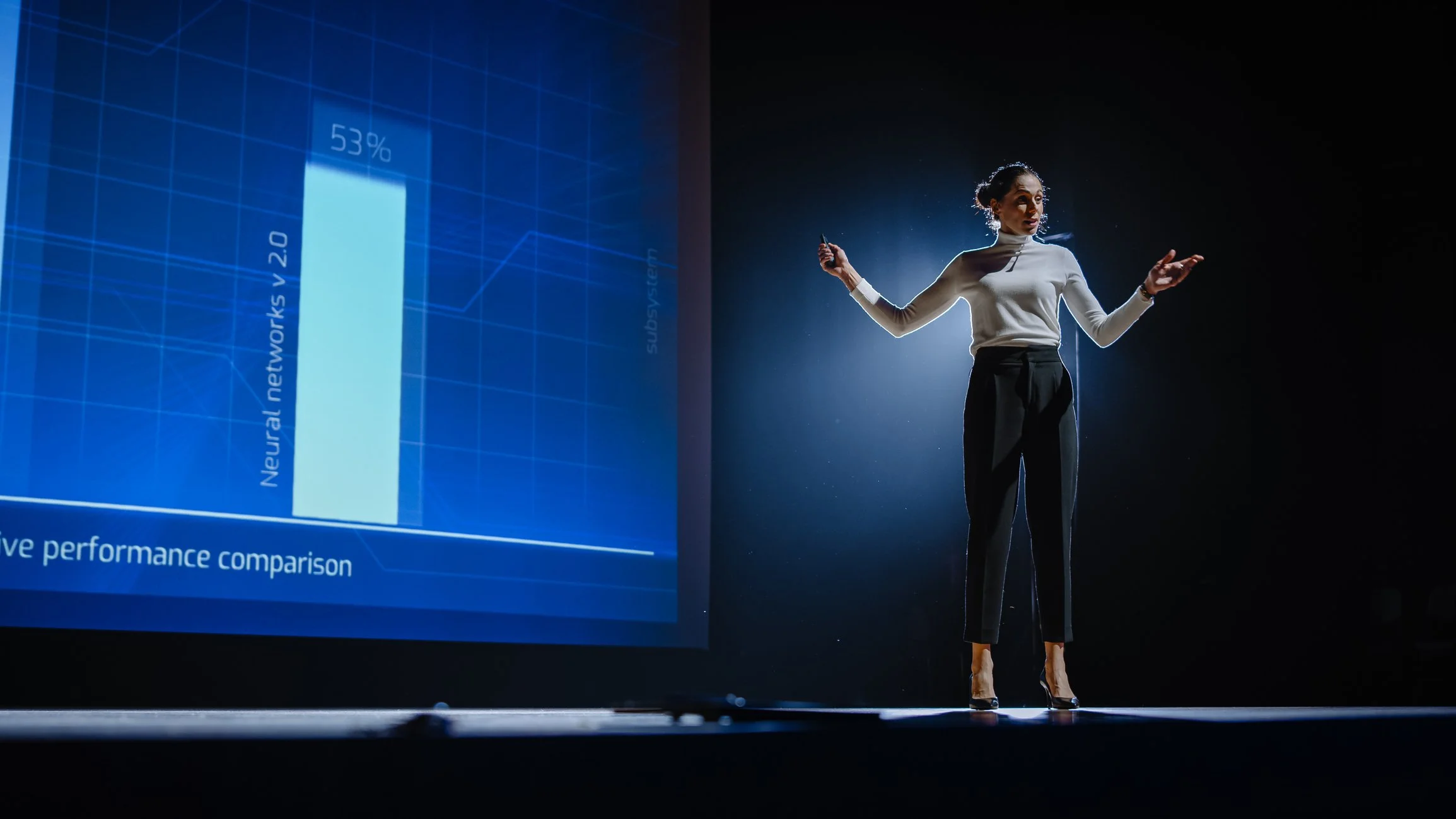
I started watching the audience before Laura even walked on. They were on their phones or talking to the person next to them. Laura entered the room. I could feel something change in the room as they watched her walk. It was the way she was walking. They could see she carried herself differently.
Laura walked with “executive presence”. Not rushed, at ease, with calm authority. She owned the room.
Laura walked to the center of the stage and paused, calmly looked the audience over for a moment, both sides of the room, smiled and said, “Hello”. I felt the audience‘s mind go silent. It doesn’t get any better than that.
There’s something that many amateur presenters don’t know. You’ve heard the expression, “You had me at Hello”? I always tell people that’s too late. A really great presenter has them BEFORE they say “Hello”. And Laura had them with the way she walked in. That’s the power of executive presence.
I had worked with Laura to help her develop this level of executive presence. The key to successful executive presence is getting it to fit you. It’s not some way of being that is unnatural to you. But it’s not the way people are used to being when they’re used to being mostly casual.
Executive presence is the presence of someone who commands respectful attention, created by their state of mind which is composed of poise, authority, and dignity, resulting in a felt presence.
It’s not what you’re doing, it’s how you’re being.
Your executive presence has to feel comfortable, completely natural, completely at ease. It has to really belong to you. It has to feel like something you own naturally and effortlessly. When you have it, you own the room and you command respectful attention.
Laura had it. As she started to speak, their faces softened. Their eyes grew more intent, a sign the audience is fully absorbed in what the speaker is saying.
You don’t want the audience thinking, you want the audience listening. If they’re even slightly thinking about what you’re saying, they’re detached. You want them to let go and just hear you.
A real presenter makes that happen, and Laura did.
As they listened to her, they leaned forward slightly. That’s what I was looking for, and I was looking to see how quickly Laura could make that happen. She did it in less than five minutes.
And then the next good sign happened. When Laura looked at someone, they smiled. And they nodded. And then the next person smiled and nodded. And then the next person smiled and nodded. And somehow these exchanges were transmitted throughout the audience, and the rest of the audience started to smile and nod, even when Laura wasn’t looking directly at them. Slight smiles and small nods, but unmistakable. The audience was communicating back to her. This was good.
Again, I was looking to see how quickly she could get them nodding.
I could tell by Laura’s tone that she was aware of the positive energy coming back to her from the audience. This positive interchange is called rapport. Many people can create it one-on-one. It’s a skill to create it with a group.
There was a moment where Laura lost them. Their eyes looked less intent, they started to fidget and a couple of them looked at their phones.
I turned around to see what Laura was doing. She wasn’t watching them anymore, she was in her head. I waited to see how long it would take her to recover.
Not long. Laura stopped thinking, she looked at them, saw what was happening and paused. She got her bearings, smiled and reestablished her connection with them, and pulled them back to her. She made it look easy.
Laura’s ending was spectacular. I was watching them and many were nodding. The ones who weren’t were very intently watching her and fully engaged. The applause was warm, genuine, undistracted and, best of all, lasted a long time.
They mobbed her immediately after. Prospective customers and thought leaders waited to talk with her. A reporter for a major industry journal was one of them, and published a glowing story about her that started a flood of positive reactions online.
Most presentation training and coaching focuses on the presenter: confidence, polish, style. Audiences don’t reward that as powerfully as they reward being transformed by a presentation.
Our work focuses on the audience. What matters most is the lasting change you are able to make in the audience. The personal growth may be in you, but in our work, the real transformation happens in the audience.
What Laura demonstrated wasn’t talent or charisma. It is a way of being combined with what you say that can be learned, practiced, and owned. Executive presence and being compelling aren’t reserved for a certain personality type or job title. They can be mastered if you’re willing to do the work to develop them, and the return on that effort shows up every time you walk into a room.
Be the cause!