Executive presence doesn't work with training wheels

Many executives who come to me for executive coaching come prepared with their word-for-word script.

What’s the problem with speaking from a script when you’re giving a presentation?

Well…what does a script say about your mindset? About your thoughts and feelings about yourself? Your feelings about the audience? About your true power?

Having a script sends out a lot of messaging about you that you might not want to be sending.

Daniel's "crash course" for impressing senior leadership

What Daniel ran into is what all human beings run into: the more you try to impress others, the more you move away from your true self. You get tangled up in knots. The more you do it, the less impressive you become.

People are not impressed by someone who is trying to impress them. It’s a road that leads to anxiety and defeat.

The two-letter secret to making your audience love you

iStock-109722746.jpg

Matt, an executive I’m coaching, recently gave an all-hands presentation to the employees who report to him, an audience of 750.  He received 100% 5-star reviews for his talk. Amazing.

When I congratulated him, he said, “Well, it was an easy audience.”

I couldn’t stop laughing.

I asked him, “Isn’t this the same audience that about six months ago was giving you a whole lot of 3’s and a bunch of 1’s and 2’s?”

He thought about it for a moment, and said, “Oh yeah! They were doing that, weren’t they?”

It was the same audience.

What this shows is it doesn’t matter what your starting point is.  Whatever it is, you don’t have to be stuck there.  You can develop your skills to the point where the audience gives you 5-star reviews.

What was the big difference in Matt’s presentations?

There were many. We covered a lot of ground during the six months of regular coaching. But let me talk about one of the most important things that happened during our work together:

Matt went from talking at his audience to talking to them.

You wouldn’t think that a couple of simple two-letter words would have such a profound impact, but they make all the difference when it comes to the foundation of your presentation ability.

At means in the direction of.

To means so as to arrive.

You don’t go at New York. You go to New York. It’s a destination, a point you reach.  You ARRIVE

You don’t look to a wall. You look at a wall.  In the direction of.  You don’t arrive there.

Big difference.

Most people are talking at their audiences. Their audience is a wall.  They’re just talking in their direction.

These presenters don’t have their ideas or messages actually arrive.  And they suffer the consequences.

What you’re doing in a presentation is getting an idea from your mind over to the minds of your audience. If you just project it in their direction, it will not arrive.

It takes deliberate awareness, intention and skill on your part to get it to arrive.

Matt’s message didn’t change.  Matt’s audience didn’t change.

Matt started talking TO them.  This woke them up and they got it.  Matt’s ratings completely changed.

Developing this skill to the level that Matt did takes focused work best done in a coaching-type environment where you’re getting real feedback.

The good news is that you can take the first few steps on this journey all by yourself, starting right now.

Here’s how:

This week, notice when you’re talking at, and switch gears and talk to them.  Get your idea to arrive.

See how this simple change makes you focus your attention and intention. See the extra power that it gives you.

Be the cause!

Presenting to skeptics

portrait-of-cheerful-businesswoman-with-arms-folded-standing-in-front-picture-id692496396.jpg

Mara’s first “practice run” of her presentation in the workshop rubbed everyone the wrong way. She was too forceful.  And her voice had an edge to it. 

I asked her what she was doing and Mara said, “My audience is somewhat closed to what I’m presenting. This is a big deal and I need to persuade them.  A lot’s riding on it.”

Mara’s story highlights the importance of being able to communicate effectively with someone you anticipate will be closed or skeptical.  Especially when a lot is riding on it.

When you allow yourself to focus your attention on the expected skepticism, it changes you.  You are now talking to their skepticism, not to them.  You start to resist the other person.  You may even feel you need to overcome their skepticism. 

The kiss of death is when you start to feel the need to convince.

This is guaranteed to bring out the worst in you.

Many people are not able to “be there” comfortably and face a person or group they assume will be closed or skeptical.

Receptive means willing to receive or accept.

You create receptivity.

Whether your audience is 1 or 100, you have no chance of opening them up and making them receptive unless you can be there comfortably and face them. 

The ability to comfortably face another person is one of the highest communication skills there is.  There are a thousand ways to run away from it.

One person wrote me that her boss is really difficult to communicate with, and so she imagined she was talking to her cat while she looked at and talked into the camera during their virtual meetings.  She said that really helped her.

Well, okay.  I can imagine that it would be more comfortable than thinking she was talking to a boss she didn’t like, but it’s a long way from being aware of the real person who IS there, a long way from being able to be comfortable, and face them in the moment, with the full power of your awareness.

In Mara’s case, it was even worse.  People create anxieties and problems, and make it difficult for themselves to face others, when they anticipate what’s going to happen, rather than being in the moment. 

In the corporate world I live in, people are constantly anticipating.  This keeps them on edge, slightly anxious.  Rarely in the moment. 

When you worry someone will be closed, skeptical, stubborn, or any of a hundred other adjectives, you’re anticipating.

That anticipation alone is enough to change you, to make you try to convince, resist or overcome.  This only makes the other person wary, closed, skeptical or stubborn.

Only when you are fully in the moment and aware are other outcomes possible.  The truly positive outcomes.  The happy transformations.

In other words, you will be most creative, most powerful, when you are in the moment.

That’s what Mara did with her real audience (which was about as closed, skeptical and stubborn as they come).  She emailed me this morning:

“We had this morning the meeting and it REALLY worked! I kept looking into the camera and had a very relaxed voice and they fully opened up… we had phenomenal interaction and are having a next meeting and I have all required information we need to make that successful!  THANK YOU!!!”

Notice your conversations this week…

How much of the time are you anticipating what’s going to happen?

See if you can stop the mental noise and just be in the moment with that person or group.  See if you can sustain it throughout your meeting or conversation. 

Get ready to be surprised.

Let me know what happens.

Be the cause!

Activating new channels of awareness

iStock-1188456646.jpg

Last week, I wrote about Carla whose virtual audience during the workshop completely changed as she gave her presentation.

Their faces in the little squares on the screen went from coldly severe to eyes shining with intense interest and some unbelievably warm smiles.

I heard from many of you when I asked for your thoughts on how Carla created that.  Carla faced a challenge that many in the world of virtual presentations face.  And few have mastered.  This can help you.

Putting yourself in Carla’s shoes, the difficulty is that when you look into the camera lens, you don’t SEE an audience.  And, if your audience is skeptical like Carla’s was, when you look at the computer screen, all you see is a wall of unconvinced faces.

In other words, you’ll get no encouragement from cold machinery or from an icy audience.  Especially at the beginning of your presentation.

Everything must come from you.

Not easy in this environment.  Talking directly to the camera lens is necessary, but it throws many people.  They freeze up.  They’re stripped of all that makes them comfortable in conversation.  It feels like “no one is there.”  No one to connect with. 

That becomes reality.  An ugly one. 

Being causative is all about creating the reality you want.  About transforming the “reality” in front of you into the highest ideal you can envision.  Creating a new reality.  The one you want.

Carla took one audience reality, one audience experience, and created another one, a completely different one.  The one she wanted.

Here’s what you need to know:

Just because you can’t see the audience, doesn’t mean they aren’t there.  They ARE there.  They ARE real people.  And they WILL respond like real people when you become someone they can connect with.

Your first step in this transformation is to move from “needing to see them” to simply KNOWING they are there.

It has to be real to you that they are there.  They have to be real to you AS PEOPLE.

Otherwise you’re just going to be talking, but you won’t be talking TO anyone. 

You’ll talk too fast, you’ll be disconnected, they’ll be disengaged and you won’t reach them.

Even beyond that, you need to be aware of them as you talk.

Effective communication is all about awareness.

Even through all the virtual machinery, people can tell whether you’re aware of them or whether your mind is somewhere else. 

They can tell whether you’re self-conscious, overly aware of yourself, whether your attention is consumed by anxiety, or making sure you cover all your material, or trying to remember what you want to say next.  All of these lose the audience.

The people in your audience can tell exactly how aware of them you are.

When you are aware of them, it greatly perks up their attention and they tune in.  They get interested.  They engage.  First with their minds.  Then with their eyes.  Then with their smiles and their words.

It all starts with your ability to really BE there and be aware of the person or persons in front of you. 

Stop telling yourself that you “need to see” them.  You are perfectly capable of being aware of them.  They are there.  Start KNOWING they are there.  Start opening up your other channels of awareness.

Notice your conversations this week.  See if you can stop the mental noise and just be fully aware and in the moment with that person.

When you can do that, you’ll get a glimpse of the power you have to impact others.

Let me know how it goes!

Be the cause!

The quickest way to warm-up a cold & skeptical audience

iStock-949582374.jpg

Carla was practicing her presentation in a recent Mastering Virtual Presentations workshop.  The audience was a grid of cold squares arranged across the computer screen.  Faces grim, mouths turned down at the corners, flat, dead eyes.  A detached virtual audience, completely unmoved by Carla’s words.

Three minutes later, Carla presented again.

She offered the very same presentation, with the very same words, to the very same audience.

Everything was the same.

Everything except the results. Those were very different.

This time the audience was leaning forward, looking at their screens with love.  Smiling.  And several of them were smiling so big, you could see dimples. Their eyes were glowing with interest and affinity.

I took screenshots of both audiences and when Carla asked me, “How did I do?”  I showed her both of the dramatically different screen shots of the exact same audience.

What changed that audience in less than three minutes?

Imagination.

Carla’s imagination.  

For you, it would be your imagination.

Here’s what happened.  I was helping Carla prepare for a very large presentation she’ll be giving this month.  It’s not large in terms of number of people.  There will only be 5-10 people in her audience. But it’s for a contract that’s worth billions of dollars.  Competition is fierce. Carla’s competitors are way ahead in the industry. Carla’s company is a new player. Some of the features she’ll be presenting are unproven.

Carla told me before I started coaching her, “They’re going to be very skeptical end closed-minded.”

After the first time she gave her presentation, the one to the very frosty audience I described above, I asked Carla, “What were you imagining about your audience?” 

Carla said that, as she was speaking, in her mind’s eye she could see the face of the most skeptical and closed-minded person in the audience that she knew would be there.

And that’s exactly what she got.  Her audience was grim, cold like statues. Their faces totally skeptical. Closed-minded.  Not sold.

Then I told Carla to look into the camera lens and imagine a person who really got what she was trying to tell them, who really got how good her product is and who was thinking, “I really want that. I love what she’s saying. I’d love to work with a fresh player.  It’s perfect.”

It took her a moment, but Carla did it.  And I took a screenshot of that audience as she was speaking.  Same people. Completely different audience.

Leaning forward.  Connecting.  Completely engaged.  Intense interest.  Warm smiles and great warmth in their eyes.

I would show you the screenshots, but it would be a complete violation of privacy, not to mention the non-disclosure agreement I signed!  But trust me, it was a dramatic night and day transformation.

Can you figure it out?   Carla said the same words.  Why did the audience transform?

Tell me what you think.  I’ll dive deeper into this next week.

Be the cause!

The decision every great speaker must make

GettyImages-1049293340 (1).jpg

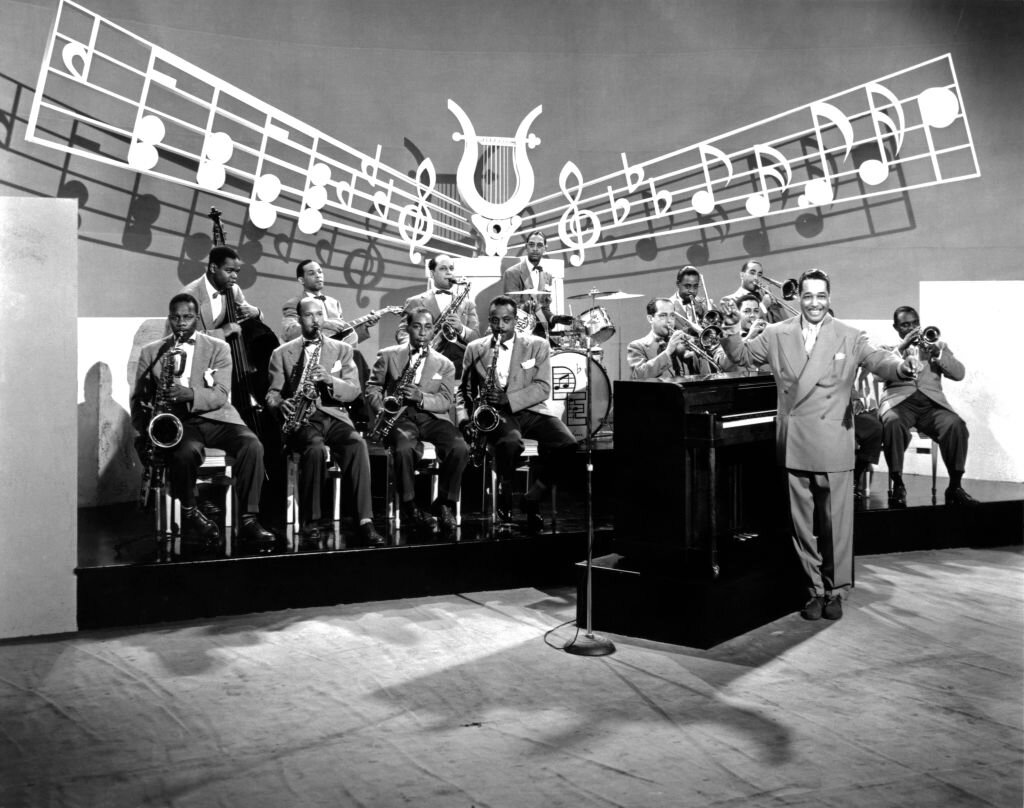
“Now, everybody look handsome!”

These words were tradition, Duke Ellington’s final command to his band backstage right before they walked out front together to face an audience and begin one of their legendary performances.

They lived on the road, the tiresome road, bedraggled nights spent far from home in lousy cheap hotel rooms, food on the road more rotten than good, each night a new restless crowd of unknown strangers.

“Now, everybody look handsome!”

And they did.

Duke Ellington.  For over forty years he was one of the most loved and longest lasting of America’s star performers.  He made a real performer out of everyone who played with him.  Some of them heroin junkies, and even they performed brilliantly under Duke’s command.  Musicians who left his band often came back because only Duke knew how to dazzlingly bring out the full glory of the music they felt inside them, to showcase their personal performances like brilliant diamonds on black velvet to loving audiences.

When it came to audiences, Duke Ellington had genius.  

Duke Ellington knew how you face an audience.

You don’t face them with doubts about yourself.

You don’t face them with doubts about your ability to create. 

You don’t face them with questions about your ability to deliver an outstanding audience experience, about your ability to craft an experience they’ll be glad they came for, an experience they’ll remember.

There’s a decision every great performer, presenter or public speaker must make:

It’s the decision about who you want to be.

Duke Ellington made that decision easy for every member of his band.  He made the decision for them:  You are a handsome and outstanding musician.  For the women:  You are a beauty and your song will penetrate their hearts like a hot knife through butter.  There were no other options when you worked with Duke. 

He commanded it.  He demanded it.  He gave them a last look that said, “Be it.”  They did, and then a split second later they were on.

And audiences loved them. The world over.  They loved Duke.  They loved his band.  They loved his singers.  They bought all his albums.  They sold out his concert halls. For over 40 years.

Skip the angst. Skip the doubt. Skip the self-criticism. Skip trying to find out what’s wrong with you. Skip thinking about how unprepared you are. Skip wondering how you’ll do. Skip being afraid.

Handsome is an attitude.  Beautiful is an attitude.  It’s a decision.  Your decision.  It’s a command you give yourself.  It’s how you carry yourself.

Look handsome.  Look beautiful.

Be the genius, be the great artist that you are.

Be the cause!

Disarming hostility with words

iStock-1127684328.jpg

One afternoon I received a call from the City of Berkeley, a charming little city right next door to the one where I work. The person calling asked, “Would you like to give back to the community?”  I said I would love to.

He told me that there was a group of teenagers who were in an “alternative program”.  They needed to learn communication skills and would I teach them for free?  I said, “Sure.”

Then he told me they had all been charged with violent crimes with weapons and were now in a program that was an alternative to prison to help them learn how to deal with life so they wouldn’t resort to more violence.

The City felt communication skills should be a big part of what they needed to learn.  I said, “Absolutely”, I was happy to help.  I donated a series of Saturday mornings.

On the first Saturday morning, I arrived at the office and they were outside waiting for me. 17 large, much larger than me, and sullen.  Eyes filled with resentful distrust. They filed inside the training room and sat down, refusing to make eye contact, looking around the walls, at the floor and out the window. Acting like they couldn’t hear me.

It was easy to see none of them wanted to be there. I quickly figured out they must have been told, “You can do this program or you can go to jail.  And you have to do this communication training as part of the program.”  I started to laugh because I was suddenly struck by the thought, “Well, given the choice, I really am better than jail.”

They weren’t in prison, but they had the sullen faces and defiant eyes of prisoners.  And now they were my prisoners.

I wasn’t in a rush.  My eyes took them all in.  They were from a part of Berkeley I had never seen.  They weren’t from the tree-lined neighborhoods, nor were they from 4th Street where so many charming shops are.  No, they lived in a world I had never encountered.  A world I knew nothing about.

How do you cross from one world into another?

I said, “Communication is about how people exchange ideas.  There’s nothing more powerful than an idea, your idea.  But only if it’s effectively communicated.” 

“I’m going to teach a communications course now. People tell me it’s pretty good. That does not mean that you’re going to like it.”

“I only teach people who want to learn. It’s perfectly okay with me if you don’t. If you’re not interested, feel free to take off.  Or you can check out the rest of the office or hang out outside.   Out back there’s a large deck and a grapefruit tree with a lot of grapefruit on it. The grapefruit are really good if you like grapefruit. Feel free to take some grapefruit with you when you go.”

“I only want the people to stay in the room who really want to learn about communication. The rest of you should feel free to leave or wander around.”

I honestly thought they would all get up and go.  About half the class left.  I went around the room with the ones who stayed and found out what each had done to get them into the program. Pretty scary stuff.  

I began to understand their world.  And I understood them.  Then I started to teach them.  In their language, for their world.  And I began to teach them my language.  And a new world.

It went well.

The next Saturday, the whole class was back. Turns out the ones who stayed told the others they had to come back, “and learn this stuff”. It was funny because there was one girl who literally dragged this really huge guy into the room by the ear, sat him down in the chair and sternly poked her finger at him and told him to pay attention saying, “You need this!” She kept him in line.

It was funny, they actually kept each other in line. When one of them started to act up, the others would get on them and tell them to pay attention.

Anyone who’s had coaching with me knows my students do a series of challenging drills or exercises that demand tremendous communication competence.

I put these kids through the toughest of drills.  Their communication skills needed to match up to the world they lived in, a world that cut them down every chance it got.  I demanded more, got more and only passed them on a drill when their ability was stable and would hold up to and penetrate the fierce violence they faced every night.  It was a lot of practice.  Scenario after scenario.

In this way, they developed some heavy-duty communication skills, one skill at a time, with me challenging, challenging, challenging.  We did this until they could get their ideas across and make themselves understood.  Until they could understand others.  Until they could confront and disarm hostility with communication alone.

As we went on, they treated me with more respect than I usually get from a typical corporate audience. When you earn their respect, it’s powerful.  They treated me like a queen.  They really made me feel special.

Then, the funniest thing happened. The class would be over around 12 PM and I would go to my desk to work on my weekly admin.  And they would hang around, cleaning the place. They would straighten chairs, empty trash, pick grapefruit up from the ground and put it into bowls (laughing here – turns out they hated grapefruit and never took any home after the first time they tried it).  They put order back into the place.

They liked the space.  They took care of it.  They hung out and would occasionally wander into my office to talk to me.  They asked a lot of questions.

We soon finished the series of training sessions and came upon their graduation. They were walking out as people who could handle the world around them, their world, with communication, as skilled communicators. There was a feeling between us that’s impossible to put into words.  Respect, admiration, love.  And, most important, hope.  There was hope in their eyes.  I wished them well.  We were all a little sad.

Then, a couple of weeks later, to my surprise, they started showing up again.  I would be working in my office and they would come around. They would clean up around the place, straighten things up, pick grapefruit.  Sometimes they would wander over to tell me something.  Sometimes they would just hang out.  I loved listening to them chatting, talking, good naturedly teasing each other, laughing.  Their voices created a music that only the voice of friendship creates. It was a completely different tone than the first time.  They were doing well.

As far as I know, none of them ever got into trouble again.  My purpose was to help them live out what C.S. Lewis meant when he wrote:  Hardships often prepare ordinary people for an extraordinary destiny

I know that the ability to communicate gives people that chance.

Our two worlds could not have been more different. The first time we looked into each other’s eyes, we were looking into very strange territory for each of us.

What united us was a hard-won understanding.

Only understanding enables us to cross into another’s world, and for them to cross over into ours.  And only communication enables us to build that bridge to cross.

Once we crossed over, we found ways to help each other.  It’s help that seals the deal in any relationship.  It’s help that builds our strongest relationships.

I helped them.  They helped me.

Understanding and then help.

I started this series with an article about How to Melt Resistance.  It’s clear that understanding is the key.  It’s always the key.  And it’s communication that makes that key turn in the lock.

You can fight.  Or you can communicate.

You can fight.  Or you can help.

They taught me as much as I taught them.  They understood me as much as I understood them.  They helped me as much as I helped them.

I don’t know if I gave back to my community. 

I do know that we became community.  A beautiful one.

Communication, understanding and help.

Be the cause!