Executives want you to be comfortable when you’re presenting to them. Yet, most of the people who come to me to polish their executive presentations are FAR from comfortable when they have a high level executive audience.
The tortured life of Senior Leadership
Senior executives spend their days listening to endless proposals and briefings. They sit through so MANY presentations, it TORTURES them to listen to presenters who don’t get right to the point.
I’m sure you watch YouTube videos. Have you ever watched one that took a long time to get to the point? You know that feeling you got? Did you ever fast-forward hoping they would get to something good? Did you ever skip out before the end?
Senior executives LIVE with that feeling.
It’s torture. There’s no other word for it.
I’m sure they would wish for a remote control that could fast-forward. And they would use it liberally.
This is how to stand out from this crowd in your executive presentations:
Executive presence doesn't work with training wheels
Many executives who come to me for executive coaching come prepared with their word-for-word script.
What’s the problem with speaking from a script when you’re giving a presentation?
Well…what does a script say about your mindset? About your thoughts and feelings about yourself? Your feelings about the audience? About your true power?
Having a script sends out a lot of messaging about you that you might not want to be sending.
The price of silence
Then she would ask, “Are there any questions? Are we all on board?”
Crickets. Dead silence.
Lucy was a little relieved there were no objections. Then she would say, “Okay, moving on…” And go to the next item on the agenda. She was terrified that they would object to her plans, and she had no idea how to handle it if they did.
Your presentation Mojo or Getting your Mojo back…
When something bad is “inevitable”
Daniel's "crash course" for impressing senior leadership
What Daniel ran into is what all human beings run into: the more you try to impress others, the more you move away from your true self. You get tangled up in knots. The more you do it, the less impressive you become.
People are not impressed by someone who is trying to impress them. It’s a road that leads to anxiety and defeat.
Pecked to death by feedback
When they have no idea what you’re talking about
The two-letter secret to making your audience love you

Matt, an executive I’m coaching, recently gave an all-hands presentation to the employees who report to him, an audience of 750. He received 100% 5-star reviews for his talk. Amazing.
When I congratulated him, he said, “Well, it was an easy audience.”
I couldn’t stop laughing.
I asked him, “Isn’t this the same audience that about six months ago was giving you a whole lot of 3’s and a bunch of 1’s and 2’s?”
He thought about it for a moment, and said, “Oh yeah! They were doing that, weren’t they?”
It was the same audience.
What this shows is it doesn’t matter what your starting point is. Whatever it is, you don’t have to be stuck there. You can develop your skills to the point where the audience gives you 5-star reviews.
What was the big difference in Matt’s presentations?
There were many. We covered a lot of ground during the six months of regular coaching. But let me talk about one of the most important things that happened during our work together:
Matt went from talking at his audience to talking to them.
You wouldn’t think that a couple of simple two-letter words would have such a profound impact, but they make all the difference when it comes to the foundation of your presentation ability.
At means in the direction of.
To means so as to arrive.
You don’t go at New York. You go to New York. It’s a destination, a point you reach. You ARRIVE.
You don’t look to a wall. You look at a wall. In the direction of. You don’t arrive there.
Big difference.
Most people are talking at their audiences. Their audience is a wall. They’re just talking in their direction.
These presenters don’t have their ideas or messages actually arrive. And they suffer the consequences.
What you’re doing in a presentation is getting an idea from your mind over to the minds of your audience. If you just project it in their direction, it will not arrive.
It takes deliberate awareness, intention and skill on your part to get it to arrive.
Matt’s message didn’t change. Matt’s audience didn’t change.
Matt started talking TO them. This woke them up and they got it. Matt’s ratings completely changed.
Developing this skill to the level that Matt did takes focused work best done in a coaching-type environment where you’re getting real feedback.
The good news is that you can take the first few steps on this journey all by yourself, starting right now.
Here’s how:
This week, notice when you’re talking at, and switch gears and talk to them. Get your idea to arrive.
See how this simple change makes you focus your attention and intention. See the extra power that it gives you.
Be the cause!
Presenting to skeptics

Mara’s first “practice run” of her presentation in the workshop rubbed everyone the wrong way. She was too forceful. And her voice had an edge to it.
I asked her what she was doing and Mara said, “My audience is somewhat closed to what I’m presenting. This is a big deal and I need to persuade them. A lot’s riding on it.”
Mara’s story highlights the importance of being able to communicate effectively with someone you anticipate will be closed or skeptical. Especially when a lot is riding on it.
When you allow yourself to focus your attention on the expected skepticism, it changes you. You are now talking to their skepticism, not to them. You start to resist the other person. You may even feel you need to overcome their skepticism.
The kiss of death is when you start to feel the need to convince.
This is guaranteed to bring out the worst in you.
Many people are not able to “be there” comfortably and face a person or group they assume will be closed or skeptical.
Receptive means willing to receive or accept.
You create receptivity.
Whether your audience is 1 or 100, you have no chance of opening them up and making them receptive unless you can be there comfortably and face them.
The ability to comfortably face another person is one of the highest communication skills there is. There are a thousand ways to run away from it.
One person wrote me that her boss is really difficult to communicate with, and so she imagined she was talking to her cat while she looked at and talked into the camera during their virtual meetings. She said that really helped her.
Well, okay. I can imagine that it would be more comfortable than thinking she was talking to a boss she didn’t like, but it’s a long way from being aware of the real person who IS there, a long way from being able to be comfortable, and face them in the moment, with the full power of your awareness.
In Mara’s case, it was even worse. People create anxieties and problems, and make it difficult for themselves to face others, when they anticipate what’s going to happen, rather than being in the moment.
In the corporate world I live in, people are constantly anticipating. This keeps them on edge, slightly anxious. Rarely in the moment.
When you worry someone will be closed, skeptical, stubborn, or any of a hundred other adjectives, you’re anticipating.
That anticipation alone is enough to change you, to make you try to convince, resist or overcome. This only makes the other person wary, closed, skeptical or stubborn.
Only when you are fully in the moment and aware are other outcomes possible. The truly positive outcomes. The happy transformations.
In other words, you will be most creative, most powerful, when you are in the moment.
That’s what Mara did with her real audience (which was about as closed, skeptical and stubborn as they come). She emailed me this morning:
“We had this morning the meeting and it REALLY worked! I kept looking into the camera and had a very relaxed voice and they fully opened up… we had phenomenal interaction and are having a next meeting and I have all required information we need to make that successful! THANK YOU!!!”
Notice your conversations this week…
How much of the time are you anticipating what’s going to happen?
See if you can stop the mental noise and just be in the moment with that person or group. See if you can sustain it throughout your meeting or conversation.
Get ready to be surprised.
Let me know what happens.
Be the cause!
Activating new channels of awareness

Last week, I wrote about Carla whose virtual audience during the workshop completely changed as she gave her presentation.
Their faces in the little squares on the screen went from coldly severe to eyes shining with intense interest and some unbelievably warm smiles.
I heard from many of you when I asked for your thoughts on how Carla created that. Carla faced a challenge that many in the world of virtual presentations face. And few have mastered. This can help you.
Putting yourself in Carla’s shoes, the difficulty is that when you look into the camera lens, you don’t SEE an audience. And, if your audience is skeptical like Carla’s was, when you look at the computer screen, all you see is a wall of unconvinced faces.
In other words, you’ll get no encouragement from cold machinery or from an icy audience. Especially at the beginning of your presentation.
Everything must come from you.
Not easy in this environment. Talking directly to the camera lens is necessary, but it throws many people. They freeze up. They’re stripped of all that makes them comfortable in conversation. It feels like “no one is there.” No one to connect with.
That becomes reality. An ugly one.
Being causative is all about creating the reality you want. About transforming the “reality” in front of you into the highest ideal you can envision. Creating a new reality. The one you want.
Carla took one audience reality, one audience experience, and created another one, a completely different one. The one she wanted.
Here’s what you need to know:
Just because you can’t see the audience, doesn’t mean they aren’t there. They ARE there. They ARE real people. And they WILL respond like real people when you become someone they can connect with.
Your first step in this transformation is to move from “needing to see them” to simply KNOWING they are there.
It has to be real to you that they are there. They have to be real to you AS PEOPLE.
Otherwise you’re just going to be talking, but you won’t be talking TO anyone.
You’ll talk too fast, you’ll be disconnected, they’ll be disengaged and you won’t reach them.
Even beyond that, you need to be aware of them as you talk.
Effective communication is all about awareness.
Even through all the virtual machinery, people can tell whether you’re aware of them or whether your mind is somewhere else.
They can tell whether you’re self-conscious, overly aware of yourself, whether your attention is consumed by anxiety, or making sure you cover all your material, or trying to remember what you want to say next. All of these lose the audience.
The people in your audience can tell exactly how aware of them you are.
When you are aware of them, it greatly perks up their attention and they tune in. They get interested. They engage. First with their minds. Then with their eyes. Then with their smiles and their words.
It all starts with your ability to really BE there and be aware of the person or persons in front of you.
Stop telling yourself that you “need to see” them. You are perfectly capable of being aware of them. They are there. Start KNOWING they are there. Start opening up your other channels of awareness.
Notice your conversations this week. See if you can stop the mental noise and just be fully aware and in the moment with that person.
When you can do that, you’ll get a glimpse of the power you have to impact others.
Let me know how it goes!
Be the cause!
The quickest way to warm-up a cold & skeptical audience

Carla was practicing her presentation in a recent Mastering Virtual Presentations workshop. The audience was a grid of cold squares arranged across the computer screen. Faces grim, mouths turned down at the corners, flat, dead eyes. A detached virtual audience, completely unmoved by Carla’s words.
Three minutes later, Carla presented again.
She offered the very same presentation, with the very same words, to the very same audience.
Everything was the same.
Everything except the results. Those were very different.
This time the audience was leaning forward, looking at their screens with love. Smiling. And several of them were smiling so big, you could see dimples. Their eyes were glowing with interest and affinity.
I took screenshots of both audiences and when Carla asked me, “How did I do?” I showed her both of the dramatically different screen shots of the exact same audience.
What changed that audience in less than three minutes?
Imagination.
Carla’s imagination.
For you, it would be your imagination.
Here’s what happened. I was helping Carla prepare for a very large presentation she’ll be giving this month. It’s not large in terms of number of people. There will only be 5-10 people in her audience. But it’s for a contract that’s worth billions of dollars. Competition is fierce. Carla’s competitors are way ahead in the industry. Carla’s company is a new player. Some of the features she’ll be presenting are unproven.
Carla told me before I started coaching her, “They’re going to be very skeptical end closed-minded.”
After the first time she gave her presentation, the one to the very frosty audience I described above, I asked Carla, “What were you imagining about your audience?”
Carla said that, as she was speaking, in her mind’s eye she could see the face of the most skeptical and closed-minded person in the audience that she knew would be there.
And that’s exactly what she got. Her audience was grim, cold like statues. Their faces totally skeptical. Closed-minded. Not sold.
Then I told Carla to look into the camera lens and imagine a person who really got what she was trying to tell them, who really got how good her product is and who was thinking, “I really want that. I love what she’s saying. I’d love to work with a fresh player. It’s perfect.”
It took her a moment, but Carla did it. And I took a screenshot of that audience as she was speaking. Same people. Completely different audience.
Leaning forward. Connecting. Completely engaged. Intense interest. Warm smiles and great warmth in their eyes.
I would show you the screenshots, but it would be a complete violation of privacy, not to mention the non-disclosure agreement I signed! But trust me, it was a dramatic night and day transformation.
Can you figure it out? Carla said the same words. Why did the audience transform?
Tell me what you think. I’ll dive deeper into this next week.
Be the cause!
The decision every great speaker must make
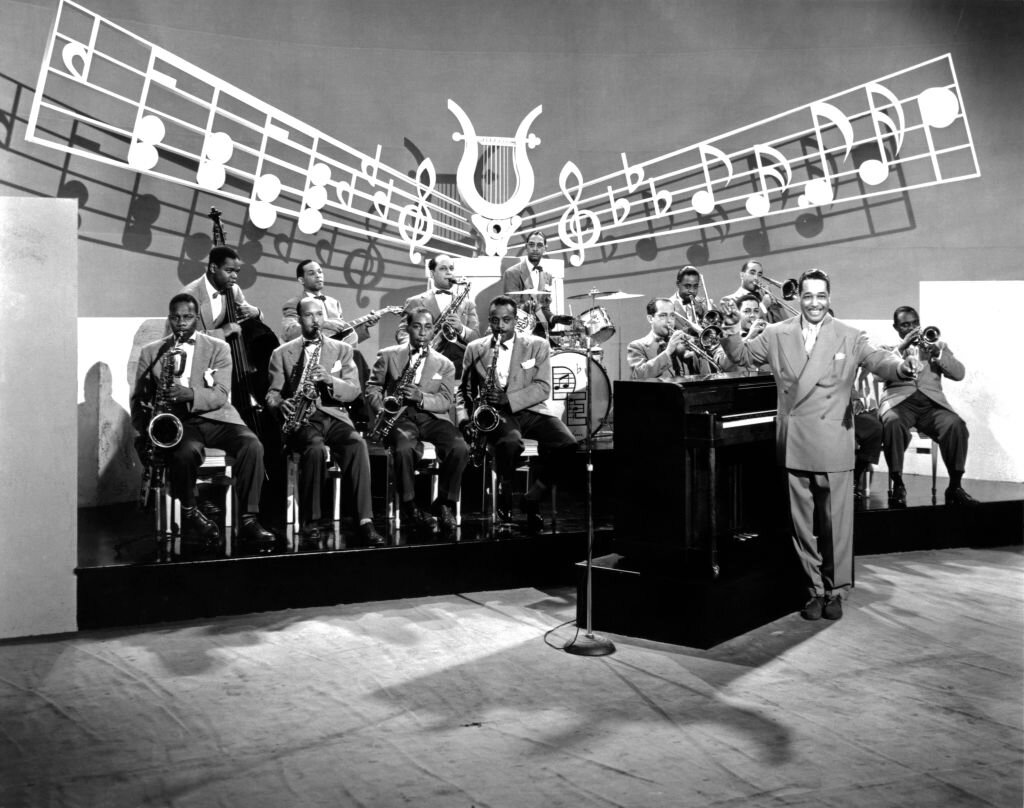
“Now, everybody look handsome!”
These words were tradition, Duke Ellington’s final command to his band backstage right before they walked out front together to face an audience and begin one of their legendary performances.
They lived on the road, the tiresome road, bedraggled nights spent far from home in lousy cheap hotel rooms, food on the road more rotten than good, each night a new restless crowd of unknown strangers.
“Now, everybody look handsome!”
And they did.
Duke Ellington. For over forty years he was one of the most loved and longest lasting of America’s star performers. He made a real performer out of everyone who played with him. Some of them heroin junkies, and even they performed brilliantly under Duke’s command. Musicians who left his band often came back because only Duke knew how to dazzlingly bring out the full glory of the music they felt inside them, to showcase their personal performances like brilliant diamonds on black velvet to loving audiences.
When it came to audiences, Duke Ellington had genius.
Duke Ellington knew how you face an audience.
You don’t face them with doubts about yourself.
You don’t face them with doubts about your ability to create.
You don’t face them with questions about your ability to deliver an outstanding audience experience, about your ability to craft an experience they’ll be glad they came for, an experience they’ll remember.
There’s a decision every great performer, presenter or public speaker must make:
It’s the decision about who you want to be.
Duke Ellington made that decision easy for every member of his band. He made the decision for them: You are a handsome and outstanding musician. For the women: You are a beauty and your song will penetrate their hearts like a hot knife through butter. There were no other options when you worked with Duke.
He commanded it. He demanded it. He gave them a last look that said, “Be it.” They did, and then a split second later they were on.
And audiences loved them. The world over. They loved Duke. They loved his band. They loved his singers. They bought all his albums. They sold out his concert halls. For over 40 years.
Skip the angst. Skip the doubt. Skip the self-criticism. Skip trying to find out what’s wrong with you. Skip thinking about how unprepared you are. Skip wondering how you’ll do. Skip being afraid.
Handsome is an attitude. Beautiful is an attitude. It’s a decision. Your decision. It’s a command you give yourself. It’s how you carry yourself.
Look handsome. Look beautiful.
Be the genius, be the great artist that you are.
Be the cause!
My meeting with 22 hostile faces

22 pairs of arms folded in hostility and grim faces filled with resentment faced me, waiting for me to speak. And I didn’t even know their names yet.
I was helping a global organization implement our performance improvement program in 23 countries. I was in France. The 22 facing me were senior union leaders and representatives. They were fighting the program because they thought it threatened their power position within the organization.
Management was tired of dealing with them. They were just going to force the program in on the organization despite the defiance. My programs don’t work that way. So management sent me in to talk to them.
The 22 faces I was looking at made their position abundantly clear.
I don’t speak French and spoke through a translator. I looked directly at them one at a time and spoke slowly. I stopped frequently so the translator only translated a little at a time. It gave the 22 union leaders a moment to fully absorb each sentence. I watched their faces while the translator was speaking.
Last week, I wrote about the power two words have to transform. In this situation, two words would not have been enough. This article is about a time when a lot more words were needed.
Here’s what I said to this group:
“I know you hate this program. I can understand that. And I can understand why. You weren’t consulted and it’s being forced on you. It looks like just another program management devised for their own benefit, as a way to manipulate you and exploit the workforce and take advantage of you. You represent the workforce and your job is to protect them from anything devious such as this. Your job is to stop something like this from being forced on the workforce.”
“You don’t like me already. You’re pissed at management because they didn’t come themselves to talk to you, that they sent me. You’re pissed because I don’t even work for the company. I’m an outsider. You don’t like me because I’m American. It irritates you that I don’t speak French. You hate having to talk through a translator. You don’t like that I’ve never worked in a union, that I have no union experience. You think that makes me completely unqualified to talk to you. And you don’t like the fact that I’m a woman. You think I know nothing.
“You don’t want to hear what I have to say. You want to crush this program into oblivion. You just want me to take my stupid program, go back to America and leave you alone.
“I totally understand that.”
“And I totally understand why you feel that way.”
“It makes perfect sense to me.”
“I really get it.”
After I finished, there was a long moment of silence.
Then I repeated, “I totally get it.” Translator translated.
Silence. We watched each other.
They were very still.
I could tell something had changed. There was a different level of interest in their eyes. Suspicious, but less hostile.
If you’ve been reading my recent series of articles, you know that what I did was acknowledge them.
However, they hadn’t said anything yet. So how could I acknowledge them when they hadn’t yet spoken?
Simple.
They were speaking to me with their eyes, their faces, their posture. I’m not stupid. I knew what they were saying with their eyes.
As I was speaking and seeing the change in their eyes, I could see I was right.
Then I said:
“I’m not here to sell you on the program. I’m not here to make you do it. I’m here to understand what’s important to you and to give you as much information as you would like so you can decide whether or not you want to do it. I’ve already made it clear to management that I refuse to implement it unless you really want it. It will be your decision. Management doesn’t agree with me, but they actually can’t do anything about that because they can’t make me do it.”
They looked at me a little puzzled. There was change happening.
Then I said, “I want to hear all about it. Tell me everything you think.”
One at a time they started talking. At the beginning, each one was absolutely filled with bitter resentment. There was a good bit of yelling. I listened for probably two hours.
Each time one person finished talking I let them know that, of course, I could totally see why they felt that way.
It was true. I could easily take their point of view and see it. I would have hated me too.
If you’re unable to see it from the other person’s point of view, you will never be able to communicate with them. It’s required in communication.
It’s not required that you agree with them, but it is required that you see life from their point of view. That you see it as if you were them.
The mood changed as they talked. At one point someone cracked a joke and we all laughed. It got friendlier.
I kept asking them if there was more they wanted to say until I could tell they were really satisfied they’d said everything. It was time for lunch.
It was surprising to me that they invited me to join them for lunch. That hadn’t been planned. And then they were very solicitous and concerned about making sure I liked my lunch, almost like I was a treasured guest, the way they took care of me while we were eating, making sure I got enough to eat, making sure I enjoyed my lunch, asking me what I was planning to sightsee while I was in France. It was surreal. I felt like I was visiting friends.
Then we got back to the meeting.
I asked if there was anything else they wanted to say and they thought about it and said they felt that they had really said everything and that I understood. They said they wanted to hear what I had to say about it.
Their faces were receptive and friendly. So I told them about the program. They frequently interrupted me. I welcomed each interruption and invited more. And I kept letting them know I could really understand their point of view. It really isn’t hard once you understand.
This went on all afternoon. I told them that was enough for one day and we would resume in the morning. They could think about it, talk about it with each other in the morning and I would come back to discuss it further with them in the afternoon. Then they would make their decision.
They said, “Fine.”
Then they all wanted to know what I planned to do for dinner. They got into a heated debate about which restaurant I should go to, all made different and passionate recommendations, a couple of them invited me to their houses, I felt like a treasured guest. We said goodbye like friends.
The next day we went back-and-forth with ideas. We were having a real dialogue. They asked questions. They raised legitimate objections and I incorporated their concerns into how the program would roll out. There really didn’t seem to me to be any problem that we couldn’t solve. They were not presenting me with any demands that were unreasonable, they were all completely reasonable. They were most definitely listening to me. Treating me like an expert even. Warm eyes.
They started to tailor my program to what they wanted to get out of it and it took on a beautiful shape and life of its own that I could never have imagined before talking with them.
I actually fell in love with all of them. I have a beautiful photograph from that trip where we are all jammed together in the conference room and they are surrounding me with these gorgeous smiling faces and we all have our arms around each other. You could tell we were having fun.
So, they rolled out the program and, no surprise, their metrics were amazing. They owned it. With pride they beat every other country location other than Denmark. Then, on their own, they started rolling it out to other parts of the organization.
I do want to digress and tell you, that at the beginning, when they were all yelling at me, I thought it was absolutely fabulous to be yelled at in passionate French. I quite liked it. There’s something about that language that is extraordinary.
Sometimes an acknowledgement only needs to be two words: “I understand”. And sometimes it’s a WHOLE lot more and takes a whole lot more words to demonstrate you really do understand. It takes real perception, understanding and judgment to know the difference.
The look in their eyes is the only guide you’ll ever need. Their eyes will tell you whether your acknowledgement was good enough, or whether they need more.
But don’t ever forget – the words are superficial window dressing. What REALLY matters is that at that moment, you are filled with pure, genuine, 24-karat understanding in its purity. Don’t add anything to that. Just see the world exactly as if you WERE them.
We’ve focused a lot on listening. For this week, focus on acknowledging – really letting them know you understand and making sure they’re satisfied with your acknowledgement, that their eyes aren’t asking you for more.
Just be prepared for real magic when you do this. You might not believe your eyes at first. But keep going with it.
You will never be the same once you experience, for yourself, the power of truly acknowledging another human being.
Be the cause!
Are you making these mistakes on camera?
I received a tremendous number of emails in response to my last article, many people tremendously grateful for a way to rebuild relationships that are being destroyed by today’s politics. Many asked for a link so they can post on their social media and I want to also provide that here for you
I’ll be writing more about this topic next week as we are on the cusp of Thanksgiving, our deeply cherished and joyous celebration of family, love, and way too much food. How do we create the great emotional, spiritual and physical satisfaction we crave during this crazy time?
For this week, I want to address a lighter topic: your camera presence.
Camera presence is how you show up for your conversations, meetings and presentations when you’re virtual.
You want to make the people you’re talking to feel like you’re right there with them. You want all the technology to melt away to create a feeling of closeness. And you want them to react warmly toward you the moment they see you.
Camera presence is a subject where small things make a big difference. Here are some of the key mistakes people make. I’ll show you with photos of Janet, our wonderful Lead Trainer. See if any of these photos look like you.
Camera angle is important. This is the most frequent mistake I see. Your camera lens needs to be on a straight horizontal line directly across from your eyes. Most people are looking DOWN at their laptop. This makes you look like you’re looking down at me. HOT TIP: We should NEVER see your ceiling. Looking up isn’t any better. You need to be looking directly across into the lens. This means putting your laptop on a laptop stand (or a bunch of books, or a box, etc) and making sure the lens is HIGH enough to be horizontally across from your eyes.
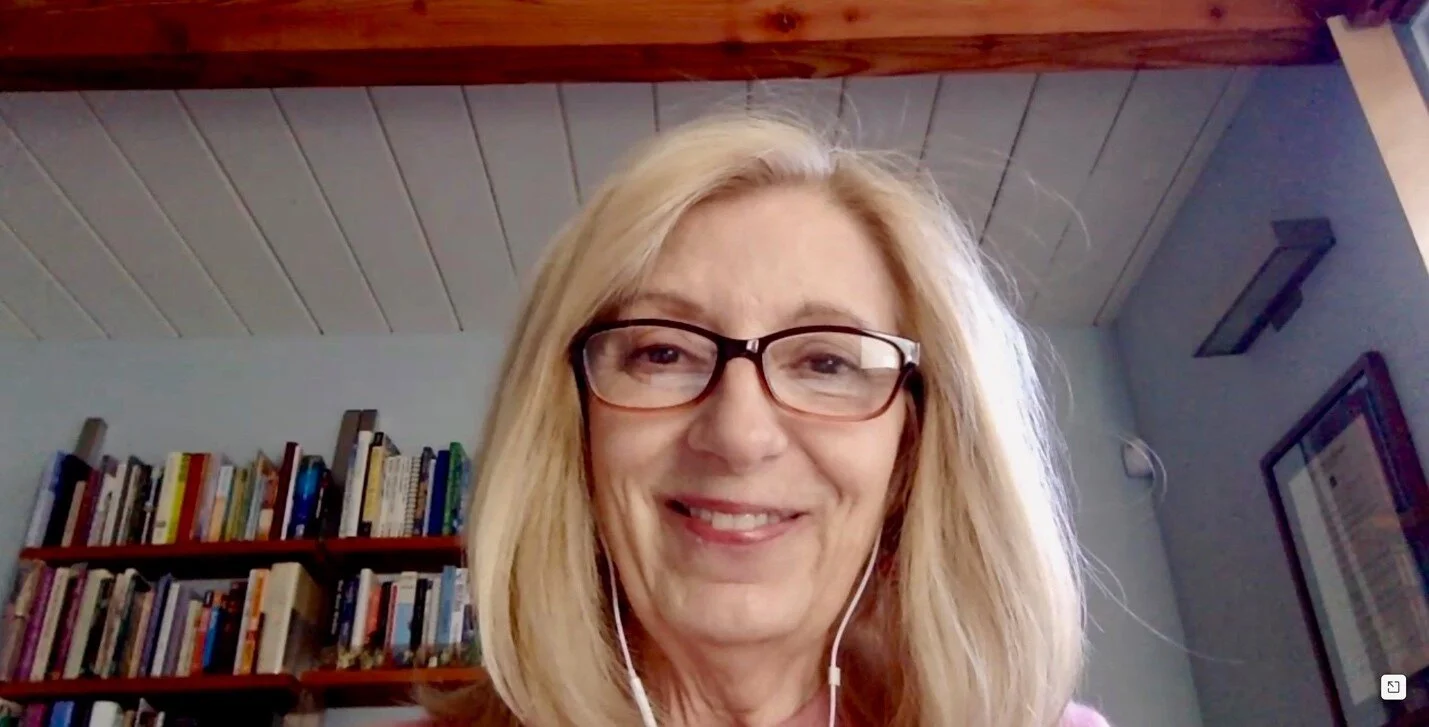
2. In Hollywood the stars know that lighting is everything. Most people are in the dark. They don’t know what ENOUGH light looks like. The light needs to be in FRONT of you. It needs to light up your face. It needs to not reflect in your glasses. See how COLD Janet looks when she’s in the dark.

3. Some people are so thoroughly in the dark, they look like they’re in the Witness Protection Program. This is mainly because the source of light is behind them (usually a window) and they have no light in front of them.

4. This is better, but many people make the mistake of lighting only half their face (usually because there’s a window on one side), while the other side of their face is dark. This does not bring out the best in you.

5. Here the lighting is good, but Janet is sitting too far away. Look at all that dead, empty space over her head and around her. Whatever she says to you will not be as impactful as it would be if she were filling the screen. You don’t feel close to her. You should fill the screen.

6. Fill the screen, but not at a weird angle – the top of her head is chopped off.

7. This is what you look like when you are looking at the other person’s video on the screen during the conversation. If you’re talking while looking at my video, it looks like you’re talking to my knee. Not impactful, not powerful, not effective. I know, I know, I know – YOU feel comfortable looking at the video and you don’t feel comfortable looking into the camera lens. I totally understand. But this is how you LOOK when you feel comfortable. Not good. You need to get comfortable looking into the lens while you’re talking. If you have any difficulty doing that, sign up for Mastering Virtual Presentations and I’ll teach you how to do it. This makes a HUGE difference in how effective you’ll be. I have a great knee, but it doesn’t deserve all that attention. :)
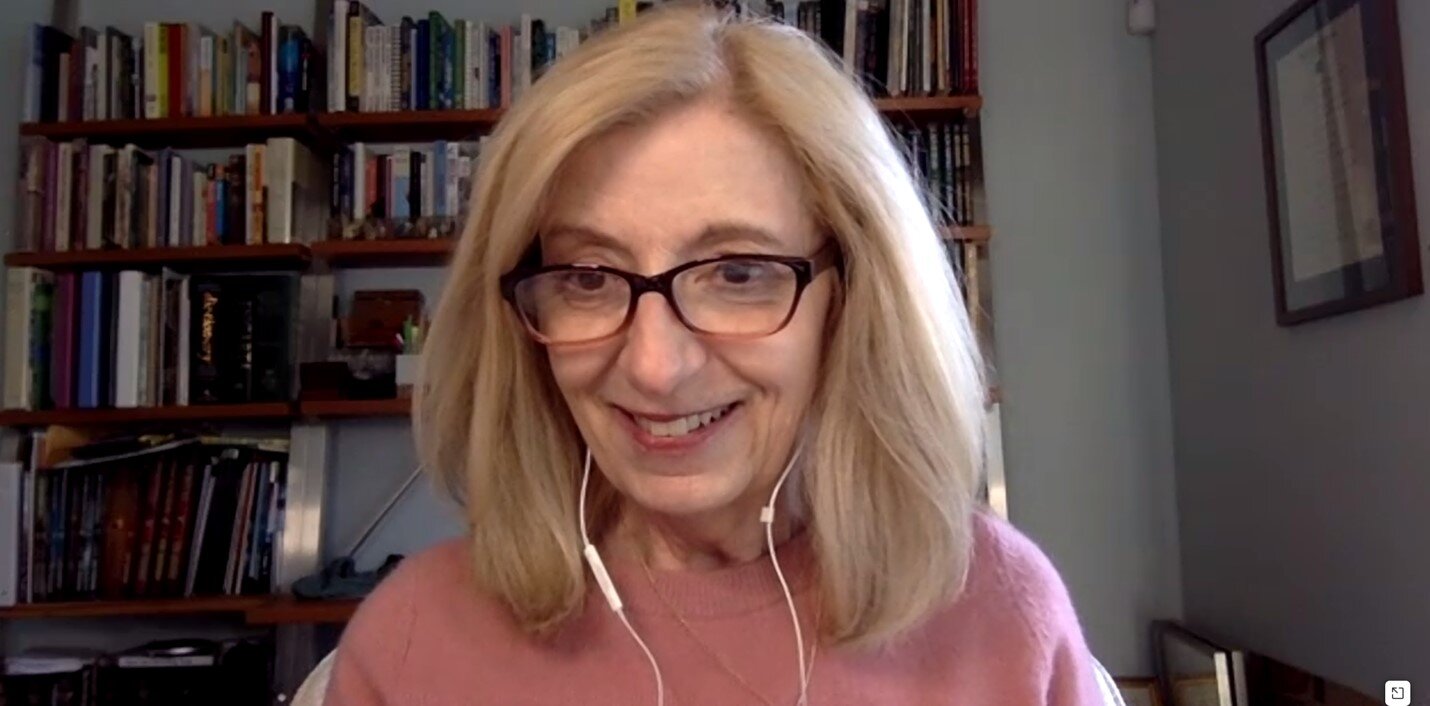
8. This is what you look like when you are looking at the camera LIGHT. You need to look at the camera LENS – NOT the light. Yes, this is better than looking like you’re talking to my knee – but now it looks like you’re talking to my left ear. Eye contact is king when it comes to human relationships and the camera lens is their eyes.

9. Here Janet is off-center. You need to be in the center of the frame for the most powerful and effective communication.

10. Here we go! The camera angle and lighting are terrific. Look how good she looks with her face fully lit up! Compare to the darker photos above and you’ll see what I mean. She’s centered and close enough to fill the screen. Looking straight into the camera lens, she looks like she’s looking straight at you. If she showed up for your meeting looking like this, what would be your first reaction? If you’re like most people, you’d like her right away. Her camera presence is great. And that sets the right foundation for excellent communication and a wonderful relationship.

Take a look through all these photos and see which person you most connect with. You can see the difference all these points make and adjust your camera presence accordingly so YOU create the best impression and relationship.
NOTE ABOUT LIGHTING: Lighting is SUPER important. You can get an inexpensive (less than $20) “Ring Light” that clips onto your laptop and a wide variety of others on Amazon. No, we don’t sell them, but you can easily find them with a search on Amazon. I and my team had to experiment with different lights until each of us found the right ones for us. Janet has a window on her left side (you can see it in the photo) and a ring light clipped to the laptop on her right side to light up the dark side. You need to light up your WHOLE face and make sure it is WELL LIT. This is important. For sure you won’t make it in Hollywood without it. :)
Please feel free to send me a screen shot of yourself and I’ll give you coaching tips on what you need to do to look fabulous on camera. I’ll do this with the first 25 screen shots I get.
Are you ready for your close-up?
Be the cause!
The First Law of Executive Logic

Harry was gritting his teeth. The SVP of Sales was (yet again) derailing Harry’s presentation to the Execs on the Senior Leadership Team, smoothly undermining Harry’s credibility.
Even worse … the execs were listening to the Sales guy.
How does Harry gain control?
Harry, the new VP Technology, prides himself on being logical. Logic is a system of thinking that enables you to reach conclusions and then take action.
Logic runs on assumptions and data.
Harry’s mistake was thinking there was only ONE system of logic: his.
To Harry, things were either logical, or they weren’t. Simple.
Harry’s assumption was that everyone runs on the system of logic that’s so obvious to him. And he was frustrated when they didn’t.
Harry’s second assumption was that others (legitimately) require robust quantity of data in order to buy into his conclusions. It was offensive to him to hear a conclusion without having ALL the data first.
So Harry had NO CLUE why senior execs multitasked while he presented every bit of his (to him vital) data.
Harry ESPECIALLY didn’t understand why the panel of Execs perked up and paid attention when the Sales SVP simply said, “I think this is a good idea. Customers will like it and it will increase revenue.”
Only after hearing the Sales SVP chime in did the Senior Leadership Team look at Harry in unison and say, “Good idea, Harry. Go ahead.”
Harry should have been happy they supported his recommendation, but he was miffed that they had to hear it from the Sales SVP. He was especially fuming because the Sales SVP didn’t present ANY data to support his statement.
Here’s what Harry’s was missing: Executive Logic™.
The logic Execs use to make decisions was foreign to him. I’ll give you one component of it.
One of the assumptions executives operate with is this: They hired you to worry about the details.
Yes, Execs ABSOLUTELY want hard data. But Harry was confusing hard data with details. Big mistake.
They TRUST you with all the details. And they don’t want to hear the them all.
If they want to hear the details, they’ll ask you questions about them. But it’s a SAFER assumption to assume that the less detail, the better.
Here is a law of Executive Logic: The further down the organization you go, the more concerned about details you should be.
The higher you go, what Executives are increasingly interested in is your EVALUATION of the data.
The details aren’t valuable. Your evaluation of the data and the details is.
That, very simply, is WHY they listened to the Sales SVP. They easily got the main point of Harry’s hard data. The Sales SVP saved them from all of Harry’s details. He evaluated Harry’s data for them and offered an easy to understand conclusion: Customers will like it. It will increase revenue.
The trust Execs had placed in Harry to evaluate the data and manage the details, very simply, was not part of Harry’s logic. Trust was not logical in Harry’s universe.
He couldn’t fathom how the Execs could give him so much trust without seeing all the data themselves. As a matter of fact, it was illogical.
Harry also had a hard time wrapping his head around the fact that the Execs were not the least bit interested in the details. How could that be? Personally he found the details fascinating, so this was doubly hard for Harry to grasp.
So much for Harry’s logic.
Harry got that his logic was PERFECT … at his level and below. But NOT when he needs to communicate UP. I taught him how to think like an Executive. He caught on quickly.
Harry’s presentations to the Senior Leadership Team became tight, brief, concise.
He said much in few words. Although he was ready with details if they asked, Harry presented only critical hard data. His conclusions were precise. His recommendations were easy to understand. It was enough.
Even the Sales SVP was nodding in support.
For the first time they said that Harry was, “Clear” and, ”Compelling”.
Harry was blown away. He made a brilliant observation:
“I use my logic to get to the table. I use Executive Logic to win the poker game.”
Wishing you a winning hand for your next presentation!
Be the cause!
Ingrid
The real secret to presenting to senior execs [Part 1]

“Too many words.” – a Senior VP’s answer when I asked why he sent Frank, his new VP, to me for coaching, hoping for more effective presentation skills.
Right off the bat Frank complained the Senior Leadership Team only gave him 12 minutes to present his team’s complex research. He’s a technology genius. But it’s difficult for him to “compress everything important”.
I asked him to give me a typical presentation so I could see what he was doing. He managed to keep it to 8 ½ minutes.
Frank started out with the most commonly used –the most overused - sentence in corporate presentations: “I want to talk to you a little bit about….”
Yawn.
It took Frank 5 ½ minutes to get to, “The biggest issue we have is…”
At the 7 ½-minute mark he said, “The most important thing is…”
He ended without a recommendation, closing with the words, “So, I would like your input …”
It would have been a GREAT presentation …. IF Frank had a lower-level technical audience. But he didn’t. He had the CEO of a major multibillion, multinational corporation with his direct reports.
And here’s the effect this kind of presentation has on senior execs: Most tuned out, openly multitasking, until the 5 ½-minute point. And the rest didn’t engage until the 7 ½-minute moment, a minute from Frank’s closing.
From their point of view, Frank hadn’t said anything meaningful until then.
Why is there such a disconnect?
Frank is a brilliant technical guy. What has he been taught?
The current overpowering, but misguided, system for educating brilliant technical guys almost always guarantees that their communications will be misdirected when presenting to execs.
It’s both HOW Frank organizes his thoughts AND how he communicates them.
Brilliant technical professionals use brilliant technical logic. This logic requires that great quantities of minute detail be discussed. It mandates that not only should ALL this detail be laboriously presented and defended, it should ALSO be comprehensively duplicated on every accompanying slide.
This logic blindly follows the mandate, “Prove it!”
In a technical world where absolutes are unobtainable, this logic builds slowly, painfully, systematically, to a plausible conclusion like, “Most probably this is what we should do ... unless you think that we shouldn’t.”
Executives find it excruciatingly frustrating. This isn’t how they think. This isn’t how they decide. This isn’t how they act. Yet they have to rely on the person giving the presentation to help them make good decisions and act intelligently from an executive level.
Both sides feel defeated when it’s over.
How do you cross the divide keeping technical genius from reaching the executive mind? Next week I will talk about the presentation structure that follows Executive Logic™ and creates the language of success.
In the meantime, notice if this goes on around you. I’d also love to hear your war stories of the battle for minds in presentations.
Be the cause!
What virtual audiences are hungry for

Their VP sent them for coaching on virtual presentation skills. It was obvious they didn’t want to be here. They’re Senior Directors, Senior Managers. Busy, don’t have time for this. Forced to endure. Probably secretly planning to multitask.
It was a group of 20 and, after the main intro lecture, the ETS Trainers and I divided them up for personal coaching. I took 5 into my breakout session.
I soon had them laughing. I hate seeing the misery of being forced to be somewhere you don’t want. I don’t try to make people learn something they’re not interested in. I personally had too much of that in school, where often I was more prisoner than student.
I established a fast friendship with the group and let them know I would teach them only what they wanted to know.
I asked each one how good they wanted to be. I let them know I could take them to rock star level if they wanted, but they were responsible for furnishing their own personal goals. I expected their goals to be as individual as they are.
I also warned them: the higher your goal, the tougher a coach I’m going to be. I have much to accomplish in six hours. So I don’t spend time messing around with anything not important.
I asked what level of coaching they wanted: light, medium or really tough. They all perked up by this point and unanimously requested tough coaching. They were now fully engaged. So we dove in.
As each one gave a short presentation, I got a sense of how they were currently doing it.
I can say this about all of them.
Their camera presence was uninspiring. In dark shadows, bad lighting, terrible camera angle, weak positioning. No executive presence. None.
These are leaders!
When it came to speaking, they were corporate and wooden. Stiff.
Not engaging. No chance of it. Audiences would be multitasking in less than three minutes.
Brilliant minds. Fabulous content. No impact. Yawn.
And with the birth of sudden hope that I could get them there, they all now wanted to be rock stars.
No problem.
You know why I say that? Because every ability they want is within them, just as every ability you want is within you.
Education comes from the Latin word educare, which came from the Latin ex (out) + ducare (to lead), to lead out.
And that’s what I do. I show my students how to find that ability within themselves and I lead it out of them. I lead initially, and they follow until they get the hang of it. And then they can finish the job and lead it all the way out. Then they are the leaders. Of themselves.
I often spend a good bit of time undoing all the damage that’s been done to their natural ability.
The informal and formal training they’ve gotten on “how to give presentations” often ruins it.
All these people who think they “have no natural ability” find out: not true. You do have great ability. And once you tap into it, it’s unstoppable.
I’ll give you an example that affected these five. It ties back to the reason why they were corporate and wooden.
They explained to me that they’re in a “technical field” and this is “how people in this field are.”
They had the firm belief that they needed to be “serious and professional”. And that “serious and professional” means using big words, formal language, erasing the pleasure in their hearts, killing the twinkle in their eyes, and wiping the smiles off their faces.
This is faulty education.
Professional should come from the quality of your work and serious should come from the intensity of your commitment. Both of these are demonstrated in your results, not how cold your face and your eyes are.
We got the lighting right for each of them so they showed up handsome and with executive presence. It’s politically incorrect these days for me to tell my clients that they’re handsome, but I can tell you.
When you get your camera presence right, you are handsome. Or beautiful, as the case may be. I see it every time.
Trying to be “serious and professional” (you can now read that as “corporate robot”), had diminished and almost extinguished each of their intensity.
These are VERY intense men. (I love intense people.) I gradually, gradually, gradually brought out all their intensity. I showed them how to experience and communicate that intensity while still being fully connected and in rapport with their audience. It’s glorious to see them speak now.
Learning to form a connection with their virtual audience, to speak naturally and powerfully, to really get their message to land, transformed these five.
Each of them now has charisma. Unique, very individual, powerful charisma.
As I coached each one, I had the others give feedback also. I thought I was a tough coach! They were brutal with each other once they got the hang of what I was doing. Relentless critics. But it was all done in the spirit of helping and we were laughing a whole lot. It was fabulous.
By the end, they were giving each other enthusiastic thumbs up, blown away not only by what they were capable of themselves, but what they now saw in their colleagues.
I fell in love with all five. There’s many kinds of falling in love. I’m talking about the swept away by competence kind. Of course it’s politically incorrect for me to tell them, but I’m telling you. They were amazing. Each one of them had the rest of us on the edge of our seats feeling like we could listen to them forever.
I can’t even describe the feeling it gives me to know that each one of them is now going to create that feeling with all of their virtual meetings and audiences. To know that every future audience is in for the most delightful of surprises.
Audiences are hungry for great presenters, especially virtual audiences. And these five, actually the whole group of 20 who worked with the other incredible ETS coaches, have the power now to create that charisma, anywhere, anytime, with any who.
And so do you, my friend. And so do you.
Get your camera presence right. Connect with your audience. Forget all the BS you’ve been taught about being stiff and wooden to convince the world that you’re really professional. Tap in to that charisma within you. And sweep them away.
Be the cause!
The secret to 100% engagement when you’re virtual

I get a sense of how desperate audiences are for someone who can give them REAL communication whenever I speak at conferences. It starts during pre-conference meetings with the conference organizers as they prepare me for what to expect.
I was recently asked to speak at a week-long virtual conference. I was speaking on the third day and the organizer wanted to touch base right before. So we talked on Tuesday. He said I would have to” really worry” about this group. “They’re only 2 days into the conference and they’re multitasking through everything. We can monitor engagement and it’s only around 20% at any given time.”
And then he started suggesting all kinds of techniques and gimmicks for me to use to increase engagement. Like calling participants out by name and other dreadful things my third grade teacher used to do.
I sincerely appreciated the heads-up going into my talk, but I’m antipathetic to any techniques or gimmicks. I believe in the power of new truths, in my own powers and in the intelligence of the audience.
I also believe that if the speaker isn’t good enough, the audience should multi-task – just to preserve their own sanity, especially during a week-long conference!
So, I started my presentation. The audience was engaged from the get-go. I was anticipating a challenge and there wasn’t any.
The conference organizer called me the next day, beside himself with enthusiasm, to tell me engagement for the 3 hours of my seminar had been 100%. They’d never seen anything like this. I let him know that I really appreciated his heads-up going in.
Right on the heels of that, I spoke at another week-long conference with a large international audience. This time I was on the fifth day, Friday. By this time, virtual audiences are usually as close to dead as you can get without actually burying them.
This conference organizer sternly let me know that the conference was precision-timed and no speaker was allowed to go even 60 seconds over their allotted time. I had precisely one hour. The clock would start ticking the second he was finished introducing me.
He made this clear in an email, in our 2 pre-conference planning meetings, and then just in case I hadn’t gotten the message, he told me again right before we started.
I had carefully precision-timed my talk to end precisely at the 60-minute mark, not one second longer.
It was going well and then unexpectedly halfway through my talk, the conference organizer was frantically texting my assistant, “The senior exec is loving this! Please tell her to take an extra 15 minutes! No one wants it to end!”
When I got this message, it was so unexpected, I was doing my best to not burst out laughing while wildly scrambling in my mind for, “What the heck am I going to talk about for another 15 minutes?”
And, less than 24 hours later, I was flooded with new requests to speak from that conference.
I can hear people asking, Well, how did you do that?
You should know that I am anti-technique, anti-gimmick.
Here’s what I do.
I have something worthwhile to say. Very.
I care about them. A lot.
I communicate. And I do it very well.
And I maintain a meaningful dialogue throughout. Many people think it’s challenging to do it virtually with a large audience, but I don’t find it so. That two-way interaction throughout is good for me and it’s good for them.
This is what I teach others to do too because I want to live in a world where we ALL are able to communicate with each other. As one of my clients said, “I am signing so many people up for your workshops because I don’t want to sit through any more boring presentations!”
And I don’t want anyone to ever be that boring presenter when I know the great things each one of us is capable of.
My real message to you in all this is this:
The world is being bombarded with people talking. Talking, talking, talking.
The world is starved for someone who can create a REAL connection, REAL communication. They eagerly tune in to you when you give them that. They enthusiastically engage with you. They want more of it. They are starved for it.
That is what they want from you.
You want 100% engagement? Go ahead and give them an abundance of the truly satisfying communication they are longing for. With the power of your ideas. With your powers to communicate them.
Be the cause!